This site is only being updated in part now. Existing full posts will still remain, but for new blogs and more information on me, please see my new website HERE

Showing posts with label Railway Poetry. Show all posts

Friday, 18 November 2011

Passengers, Praise and Poetry - Britain's First Restaurant Car

The age of the restaurant car has now passed on Britain’s railways. While full meals can still be eaten on the east and west coast routes, presumably with the help of a microwave or re-heating, no cooking is done from scratch anymore. The last train to provide such a service was the 19.33 from King’s Cross on 20 May this year. Passengers were served a meal of ‘Smoked Haddock Arnold, Bennett crepe’, rib-eye steak, leg of lamb or fillets of trout, followed by blue cheese, apple and walnut strudel or ginger and rhubarb pavlova.’[1] Consequently, this train ended a 130 year tradition in British rail travel. Yet, it is interesting to note that the first and last restaurant services in Britain started at the same place, London's King’s Cross Station.

The restaurant car first appeared in Britain on the 1 November 1879 on Great Northern Railway’s (GNR) route between King’s Cross and Leeds. Railways in the United States had had restaurant cars since 1869 and because of this the GNR’s were built by the Pullman Company, based in Detroit.[2] The Ludgate in 1897 described this advancement as one of the ‘greatest comforts for travellers that had been thought of since the Rocket made its trial trip from Manchester to Liverpool.’[3]
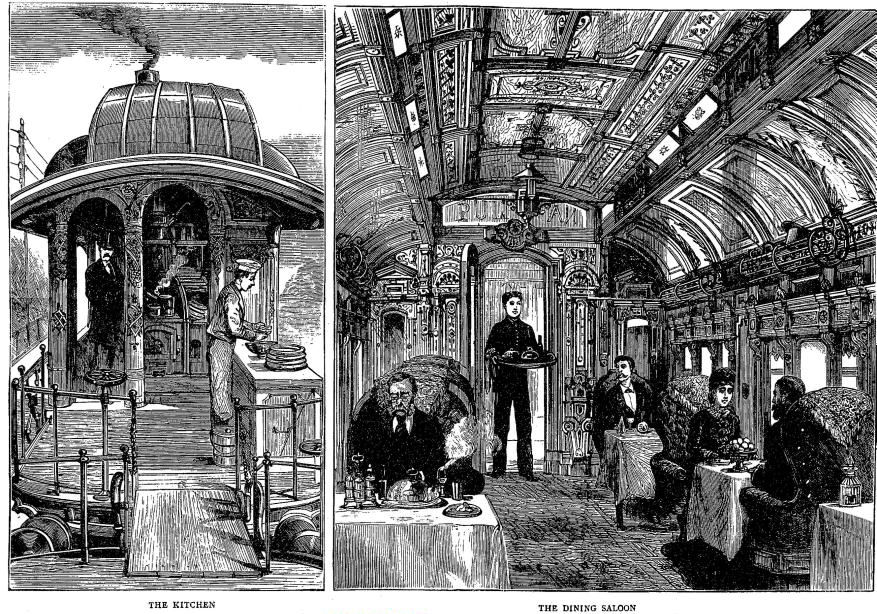
The first journey of the new restaurant car was actually a trial run on Monday 27 October 1879. The York Herald and The Graphic both described the layout of the carriages.  Firstly, as shown in the image, the two carriages that made up the service had platforms at each end which were linked together, rather precariously, by a wooden bridge.[4]  The cook’s galley was at one end of the carriage where a dedicated chef prepared ‘all sorts of good things for the delectation of hungry travellers.’[5] Passing through a short corridor, a door opened into the pantry in which cupboards were neatly arranged to hold ‘stores, plates, glasses, decanters &c’. There was also a sliding hatch, so that meals could be passed from the kitchen to the pantry for arrangement on plates.[6]

The other carriage contained the restaurant area which had six ‘snug little tables, each adapted to accommodate two guests.’ The seats were stuffed and covered in velvet and were mounted on a conical pivot for steadiness. Indeed, the whole train was praised for its smoothness, The Graphic stating that ‘the oscillation of the carriage was scarcely noticeable.’[7] Beyond the restaurant area through a corridor was a ladies’ dressing room, a smoking room with nine seats and a male lavatory. Indeed, a swing door prevented any smoke from the smoking room entering the dining area. There was also hot water heating and electric bells next to each table to alert the steward when a passenger required something.[8]

The menu on that first train consisted of six courses [9] and nineteen passengers could be accommodated by the carriage at any one time. The staff and waiters were provided by the company’s ‘Great Northern Railway Hotel’ at Leeds, and consisted of a cook, a steward who doubled as a waiter, and a boy to serve in the smoking room.[10] Given the opulence of the service it is unsurprising that its guests were first class passengers. However, unlike in later decades, when passengers moved to the restaurant car from their seats through inter-connecting corridors between the carriages, in 1879 they stayed in the carriage for their entire journey.

In the press the restaurant cars’ arrival received much coverage and they were fitted into prevailing narratives surrounding the quality of British railway food. Invoked in good measure was the refreshment room described in Dickens’ 1866 story Mugby Junction, where the food was poor and the service rude. The Standard stated that while not every station refreshment room was as bad as this fictional example, ‘we are still far behind all civilised countries’ in the matter of railway catering.[11] Indeed, Punch published a poem (shown) that including the lines ‘no more Mugby Junction Bar; no more tough ham and chicken; Nor passenger pickin’; For the minxes behind the bar.’[12] The Graphic echoed these thoughts, stating that ‘most travellers have had sad experience of the station refreshment bar…to obtain possession of a basin of scolding-hot soup or cup of coffee.’ Yet ‘this condition of things is no longer to prevail on the Great Northern Railway.’[13]

Ultimately, the introduction of restaurant cars did nothing to change the standard of British railway food. While the GNR was pioneered their use, and the London, Brighton and South Coast Railway purchased some in 1881[14], it was not until the late 1890s when companies’ were competing ruthlessly for traffic that they became more widespread. By 1897 the GNR, London and North Western, Midland and Great Western Railways had them.[15]

The reasons for their slow introduction were two-fold. The York Herald in 1879 stated that they cost £3000 to buy (and presumably they were expensive to build later), and for many companies at the time the expense was seen as unnecessary.[16] Furthermore, they were also incredibly heavy and this made them uneconomical to run in the 1870s.[17] Thus, it wasn’t until the 1890s, when companies introduced them as a unique selling point and more powerful locomotives were available, that they became a common feature of long-distance rail services in Britain.

----------------

[1] http://www.dailymail.co.uk/news/article-1388536/The-resaurant-car-As-great-British-railway-eating-experience-dies-look-heights-civilised-travel.html
[2] Harris, Michael, ‘dining car’, The Oxford Companion to British Railway History, (Oxford, 1997), p.420
[3] Du Plat, E.A., ‘Meals on Trains’, The Ludgate, 4 (1897), pp.148
[4] The York Herald, Tuesday, 28 October 1879, p. 5
[5] The Graphic, Saturday, 1 November 1879
[6] The York Herald, Tuesday, 28 October 1879, p. 5
[7] The Graphic, Saturday, 1 November 1879
[8] The York Herald, Tuesday, 28 October 1879, p. 5
[9] The Graphic, Saturday, 1 November 1879
[10] The York Herald, Tuesday, 28 October 1879, p. 5
[11] The Standard, Monday, 20 October 20 1879, p. 3
[12] Punch, reprinted in The Blackburn Standard, Darwen Observer, and North-East Lancashire Advertiser, Saturday, 8 November 1879 p. 2
[13] The Graphic, Saturday, 1 November 1879
[14] The Standard, Friday, 2 December 1881, p. 3
[15] Du Plat, ‘Meals on Trains’, pp.148-155
[16] The York Herald, Tuesday, 28 October 1879, p. 5
[17] Harris, ‘dining car’, p.420

Friday, 21 January 2011

When Railway Workers' Write Poetry

Unfortunately, I am deep into a chapter that is due in on Monday, or thereabouts. As such, I have not had the time to write any blog posts and so I thought I’d post some poems that I have found in Railway Company Staff Magazines. While I have many poems from the London and South Western Railway’s (L&SWR) staff magazine, The South Western Gazette, I have also started to photograph staff magazines that originated within other railway companies before 1923. It seems to me that while they loved to include poetry, poetic submissions were also used by editors to fill space. This said, the South Western Gazette did actually have a ‘poet’s corner’ for many years.

Many came from external sources, however, a good proportion were written by railway employees and I’m sure that the poems could tell us a lot about attitudes to work on different railways, railway workers’ concerns in different parts of the country and the lives they led. However, for now, just enjoy them (even if some of them are not great). I’ll start with a poem by J.J. Hatch, a clerk on the L&SWR, who was so prolific that he eventually had a book of his work published. This was from the April 1st edition of the South Western Gazette.

A Lost Friend

As meeting in the eventide,
A man, his journey well nigh done,
Whose face towards the setting sun
Is bright and seems half glorified.

So met I him when life was late,
His life, and loved him from the first;
My soul hath ever been athirst
For kindly hearts with which to mate;

And his was warm with gentle thought
And fruitage of congenial speech,
And so our spirits, each to each,
Were drawn, by mutual impulse taught:

He pass’d into the silent night,
And left me standing all alone,
The sunset hue of eve had gone,
And earth was darken’d to my sight.

Poems with a railway theme were actually quite rare. However, this one from the Great Central Railway Journal of April 1906 certainly bucks the trend. It is simply called ‘A Railway Romance’ and was about a deaf man called Wilkinson who had his hearing restored by being run into by a train. There was no stated author.

A Railway Romance

Wilkinson was strolling slowly,
Pensively upon the railway:
The express was fact approaching
Just behind him, but he lit a
Cigarette and hummed a ballad:
He was deaf, and so he could not
Hear th’ approaching locomotive,
Raging, panting locomotive,
Panting close upon his footsteps:
Or the driver gently whisp’ring
Lisping to the evening zephyrs,
“Wilkinson, you Crimson idiot,
“Crimson, suicidal idiot
“Can’t you hear the crimson engine
“Panting o’er the purple railroad?
“Will you-?” But his words were idle,
(Wilkinson could not have heard a
Cannon let off close beside him);
But the passengers could hear them.-
So the engine rushed upon him,
Rushed at full four miles and hour
(It was a suburban railway),
Smote him with the dreadful buffers
Right upon the ear, when-wonder-
His complaint was cured completely.
Wilkinson regained his hearing.
But when he hears the driver
Comment on the situation,
Mention his opinion of him,
Fully his opinion of him,
Then he wished devoutly that he
Never had regained his hearing.

The Great Western Railway Magazine and Temperance Union Recorder was started by the company’s temperance union in 1888. Because of its origin its content reflected the fact that the readers were expected to engage in good habits. Thus, the poems were often of a religious, clean living or pious nature. This one, from January 1889, was simply called ‘Gone!’ and was ascribed to an unnamed employee who worked at Paddington Station.

Gone!

Hark! Hark! The bell in the old church tower yonder,
It echoes, dirge-like in the midnight clear;
It bids the soul upon this thought to ponder,-
The Dying Year!

The Dying Year! The “Hand” will soon be “vanished;”
The Dying Year! The “Voice” will soon be “still;”
The Dying Year! The form will soon be banished
Behind Life’s hill.

And as the bell in toll grows slower, deeper,
A Form comes gliding on,
Murmuring, as watchers o’er the pallid sleeper,
The sad word, “Gone!”

Anon, a merry peal of bells are ringing,
The New Tear grasps a rope,
And in the air and angel choir is singing
The joyous song of “Hope.”

The Great Eastern Railway Magazine was started in 1911 by the Great Eastern Railway. Interestingly, a number of poems in the early editions were actually about the magazine itself and events that took place early in its existence. This one, from the first edition in January 1911, certainly shows one individual was optimistic about the magazine’s future. Attributed to ‘A.L.G,’ it is called ‘The G.E.R.M.’

The G.E.R.M.

Pray have you the space for one to make
A trifling observation?
Our Magazine already bears
A shortened appellation-
But one we might adopted without
The slightest hesitation-
“The Germ”!
For germs are good as well as bad,
And often quite benevolent,
Converting all to good that is
In any way malevolent.
(If thou be such, then let us pray
To see thee ever prevalent,
O Germ!)
May be ‘twill prove a germ of life
Of the most intense vividity:
A germ so precious as to be
Sought after with cupidity-
Of such content that all who taste
Will swallow with avidity
The Germ!

Well, for now I think I will stop there. I have many more for when I am having a busy period in my PhD, and I am sure the number I will find will increase.
Related Posts Plugin for WordPress, Blogger...