This site is only being updated in part now. Existing full posts will still remain, but for new blogs and more information on me, please see my new website HERE

Saturday, 24 April 2010

Why this was a big week for the rail industry

What with election fever and volcanoes, the fact that it has been a big week for the railway industry in Britain has largely been ignored by the media. I'm not talking about all those extra trains laid on by Eurostar to get people to and from Continent, nor the extra services put on by railway companies to move people around this country. I am instead talking about two pieces of news that may affect the humble traveller in the future. The first may leave you grinding your teeth, while the second may, depending on your perspective, leave you dancing for joy.

Arriva

On Thursday Deutsche Bahn, (DB) Germany's national rail operator and the world's second largest transport company, took over Arriva, who run buses and trains throughout the country. They did this for the not inconsequential fee of 1.59 billion. Of course the Daily Mail went wild, bemoaning the fact that yet another British Company was now owned by the evil foreigners. What also made the situation worse for the Mail was the fact that DB was a German company, the online headline being 'Now Britain's railways are taken over... by Germany.' Of course they handily forgot that Arriva themselves have engaged in overseas ventures, currently running trains and buses in Germany, Sweden, Denmark, Italy, Spain, Portugal, The Czech Republic, Poland and Hungary. But hey, the Mail only hates the global market place if British companies are threatened; if they are taking over companies elsewhere I suppose they see it through the prism of a new financial British Empire.

Another person that went mad, reputedly representing another interest group, was Bob Crow General Secretary of the 'Rail, Maritime and Transport Union' (RMT). Firstly, before I quote Bob, I'm going to give a warning. In the quote I will provide, it will refer to safety. But please, don't take it seriously. Anyway, are you ready? Bob said this was a "huge step in the wrong direction for rail workers and passengers". He also stated that "It should sound a warning that we're heading towards a dangerous monopoly of rail and bus services across Europe in which profit comes ahead of safety and service." There, now wasn't that fun. I think a more measured response, but equally unrealistic, came from the leader of the Transport Salaried Staffs Association (TSSA), Gerry Doherty, who said: "If Germany believes railways should be run by the state in favour of the passenger, why don't we do the same here in Britain?" In short these union chiefs simply gave rabbit-fashion sound-bites, reverting to their default positions of attacking the usual suspects of privatisation and corporate empire building. While I am against both of these things, I think that the unions should provide constructive criticism so as to stimulate discussion and allow for debate, rather than reverting to the old positions that we know they are going take. In addition, I think these unions should try and cooperate more with the industry. At some point they have to get used to the fact that the franchise system isn't going away and will have to work better with it. But then, as we'll see later, one union is.

I think that the comments of the Mail and the unions should be ignored regarding DB's new acquisition (although a consistent policy of ignoring the Mail should be adopted). A more objective approach to the takeover should be taken, weighing up the pros and cons of what DB can give to the British rail industry. Firstly lets be clear, DB is already in out midst. Firstly they already own Chiltern Railways (from January 2008) as well as what was known as 'English, Welsh and Scottish Railways', Britain's largest freight haulier, now called DB Shenker. This therefore gives us, especially in the case of Chiltern Railways, a good benchmark as to the level of service we passengers can expect from the new owners.

Guess what, Chiltern is a pretty darn good company. Over the period of 10th January to 6th of February 2010 94.2% of all their trains arrived within 5 minutes of schedule, the fourth highest Train Operating Company (TOC) for performance. Further the company service very rarely has less than 95% of trains arriving outside of the 5 minute window in any measured period. In addition Chiltern was the first railway company to pilot e-ticketing, allowing customers to print off their ticket or have it sent to their phone as a bar-code which is then scanned at the station. Since April 5th 2008 40,000 such tickets have been sold, significantly speeding up the time passengers spend waiting and queuing at stations, and improving their overall convenience. Further, on 14th December 2008, and in connection with Network Rail, the company opened a new station, Aylesbury Vale Parkway. This is a new terminus sited 2 miles north of Aylesbury, that reopened this part of the line. The company has also spent considerable money on improving and refurbishing their rolling stock.

Lastly, Chiltern agreed the Evergreen 3 project with Network Rail in January 2010. Firstly, this is to upgrade some Chiltern's main line, as well as doubling the line between Oxford and Bichester, allowing trains to run from Marylebone to Oxford direct. Secondly it will upgrade the Chiltern Main Line between Marylebone and Birmingham, that will allow 100 mph running, reducing journey times from 117 minutes to a mere 92. Overall, Network Rail say that their costs will be recovered by a 'facilities charge' that Chiltern will pay for the next 12 years (the charge to be taken over by whoever holds the franchise in 2022 when Chiltern's expires).

Chiltern also benefits from a longer franchise that most TOCs, and in 2002 the then owners signed a 20 year contract to run the service. This means that the company has been able to propose a raft of bold projects that will improve journey times, enhance the passenger experience of rail travel and make the company more efficient. A lot of the proposals that I am going to cite were initiated under the previous owners, Laing, however DB have not, to my knowledge, put a hold on any of them. Indeed many of them have been proposed after DB took over in January 2008.

In cooperation with Network Rail they have a range of improvements They want to lengthen platforms at South Ruislip, West Ruislip, Saunderton, Kings Sutton, Sudbury Hill Harrow, Sudbury and Harrow Road and Northolt Park to accommodate eight coach trains to improve capacity. They hope to add an extra track (to make the number up to four) between South Ruislip (Northolt Junction) and West Ruislip, double the line between Princes Risborough to Aylesbury and reopen the link between Oxford and Princes Risborough. In addition, their goal is to build an interchange at West Hampstead which would allow passengers to connect with London Overground, Jubilee Line, Metropolitan Line and First Capital Connect services. Further, they wish to re-open the line between Aylesbury to Bedford via Milton Keynes and the line from Oxford to Bedford. Lastly, and I do think this is a little 'pie in the sky,' they also want to extend Oyster Pay-as-you-go to Aylesbury and High Wycombe.

These are just some of the many ideas for improving the service that they have provided. I think whether you agree or disagree with the franchise system or corporate empire building, under DB Chiltern has consistently acted as we would wish a franchise holder to. They have attempted to improve the service for travellers by investing in the infrastructure, improving the rolling stock, running to time and making the traveller's journey more pleasant. Therefore Chiltern have become since 2002 an industry leader, acting as a benchmark against which all other companies are measured. DB's recent takeover of them has not affected this position and has even improved it. When DB acquired Chiltern in January 2008, they knew what an ambitious and forward thinking company they were getting, as well as the fact that they had a long-term franchise commitment. As such because Chiltern have continued with their ambitious plans and still generate new ones, I think that this must represent that DB also have an ethos of network, performance and service improvement.

Therefore, part of me is pleased that DB have acquired Arriva. It will expand the benchmarks against which those companies that do not perform well and which are driven by veracious profit motive, such as Stagecoach and National Express, can be measured. Further it will allow the passenger and service orientated ethos that Chiltern posses to spread to other parts of the British Railway industry. Lastly, and most importantly, we may see more investment, better trains and a better ride for our buck on Arriva owned TOCs.

East Coast

Earlier in my post I mentioned that I thought Bob Crow of the RMT and Gerry Doherty of the TSSA should try and work with the franchise system as it isn't going anywhere soon. The potential for unions to interact with the franchise system was given full expression on Monday when the Train Driver's union, The Associated Society of Locomotive Engineers and Firemen (ASLEF), announced that they were going to bid for the East Coast franchise that is currently run by the state after National Express had the franchise stripped from them. They will run it as a not-for-profit company, meaning that all the revenue could be re-invested in the service and potentially allowing the fares to be reduced.

Surprisingly, this news did not receive much coverage, probably the result of a big ash cloud. Indeed I had to be alerted to it by my friend Katie (thanks Katie). But this is very important news, and if ASLEF succeed in their goal then it may signal a change in the way that we start thinking about Britain's rail franchises. Firstly, as I have stated, we all have to get used to the fact that the franchise system isn't going away and that re-nationalisation is not on the cards. None of the three major parties have committed to it in their manifestos and with the massive national debt it would not feasible for the government to pay off the different Train Operating Companies and take over the services. Therefore ASLEF have shown us that their may be cooperative route to pseudo-nationalisation, that will reform the privatised network that will keep costs low, improve services and reduce fares. With sketchy information it is not clear how this proposal by ASLEF will pan out, but I feel that it is an exciting move.

Conclusion


Perhaps the events of this week, have signalled the start of the 'mature phase' of the privatised railway network, where an ethos of good service and dedication to customers can proliferate and where new ideas come to the fore. Perhaps, even, there may be a case for saying this is when the privatised network may even start to work, and maybe, at last, we can start again to have a railway network we can be proud of. But then again...we'll see.

Wednesday, 21 April 2010

1862 - The true and tragic story of Mary Ramsdale and Family

Sometimes I come across some shocking and very sad stories when doing my research on the Victorian railway. I freely admit that it is easy for historians to view groups people in the past, particularly the poorer sections of society, as homogeneous faceless statistics. We can then use the statistics as evidence and can draw conclusions. When doing my work I rarely have need to move past this approach or acknowledge that every statistic I employ as evidence was a person with emotions, desires, highs and lows. This is why the case of Mary Ramsdale and her family particularly got to me this week. I feel the need to share it with everyone as it is probably the first time that she and her family have been acknowledged individually by anyone for 150 years. Also it just made me feel very sad.

A bit of background is required. When a railwayman was killed on the line railway companies, as an act of benevolence, would employ the widow so as to give support to the family. They were employed in such roles as Gatekeepers, Waiting Room Attendants or Charwomen. These jobs were unsurprisingly very poorly paid, and women in them would receive roughly between 10 and 15 shillings a week (£34 to £51 today).

Mary was employed as a Waiting Room attendant at Southampton station after the death of her husband. Evidence from the Parliamentary accidents return shows that a William Ramsdale, the Gatekeeper at Ashley Level crossing near Ringwood, was struck by a train in May 1859 while attempting to prevent a person from crossing in front of it. Given the proximity of Ringwood to Southampton, the unusual surname, and the time between the date of his death and the story I am about to recount, it is almost certain that this was Mary's husband.

The first time that I came across Mary was in a Traffic Committee minute of January 1862 (RAIL 411/231), when Richard Beach, Superintendent of the Southampton Station, wrote to the Traffic Committee regarding a complaint made against her :-

“23rd January 1862 – 1034) Mrs Ramsdale – Read letter from Mr Beach, Southampton, reporting a case against Mrs Ramsdale the Woman in the Waiting Room at Southampton.
Mrs Ramsdale to be cautioned.”

Given her low wage, the ease with which railway companies dismissed their staff, the harsh rules and regulations of railway employment, and the difficulty a widow would have getting a job elsewhere, for Mary to be risk her employment would suggest that her mental health was not good. This was confirmed later in the year by the Traffic Committee (RAIL 411/233):-

“13th November 1862 – 387) Mrs Ramsdale – Read letter from Mr Beach, as to the case of Mrs Ramsdale attendant in the Waiting Room at Southampton who has been placed in the Fareham Lunatic Asylum. Further inquiry to be made”

What Mary was suffering with is of course uncertain, however, it seems that given the circumstances of her life after her husband's death it is quite possible that it was some form of depression. This conclusion is given further weight by her circumstances stated at the committee in later weeks.

“27th November 1862 – 422) Mrs Ramsdale – Read letter from Mr Beach, Southampton, with reference to the case of Mrs Ramsdale late Waiting Room attendant there now in the Fareham Asylum stating that the ages of the two children are one 8 years and the other 5 years. Mr Beach to inquire if Mrs Ramsdale's friends will take the children and the company will give a gratuity of £10 per year for two years.”

“11th December 1862 – 446) Mrs Ramsdale – Mr Scott reported further with respect to Mrs Ramsdale late Waiting Room attendant at Southampton. The Children to be placed in the Workhouse as there are no friends who will take charge of them.”

According to the 1861 census there were in fact three children and Beach got the ages of the two he mentioned wrong. They were Mary, aged 9, Emily, aged 6 and Hannah aged 3. Clearly Mary, with the loss of her husband, receiving a low wage, with three children and few friends around her, found her conditions insurmountable.

The last part of the story compounded its highly tragic nature for me. The three girls would have gone into the Southampton Union Workhouse. In 1865 a Poor Law Inspector described it as a place where there was the "mixing together of all classes, including old, infirm and idiots, in rooms in which it was almost impossible for human beings to live." The girls would have been together in the workhouse, however it would have been a horrible, scary experience. It is highly unlikely that they saw their mother again.

I can't tell you what happened to any of them, but at this point it just proves that Victorian Society was extremely harsh, replete with sad and tragic stories, and that perhaps I should stop quibbling when minor things go wrong in my life.

Thursday, 15 April 2010

Advertising an Exciting Project

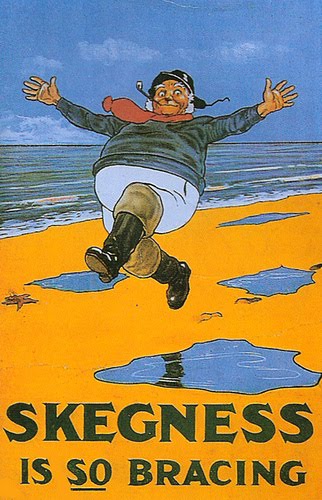
I have always been fascinated by the art of Britain's railways. Who hasn't been confronted by a 1930s railway poster and marvelled at the skill involved in producing these commercial tools. These weren't computer generated, one day productions, they were skilled pieces of work in which the railway companies, especially in the inter-war years, invested much time and effort. Indeed, a large part present society's memory of the inter-war railway network comes from these posters and the enduring images they created. When people refer to railway travel in the 30's they invoke memories of such great poster tag-lines as, 'Skegness is So Bracing,' 'Glorious Devon,' or 'Speed to the West.' This of course is a false image. Britain's railways in the inter-war years were run-down, stretched and suffering badly from competition with road traffic. However, this does show that the posters, to some extent, were successful in their aims. With other promotional tools they have helped shape our collective memory of Britain's inter-war railways.

Yet the 1930s railway poster is only one part of a continuum of commercial tools used by Britain's railways since their opening. The 120 or so railway companies that were in existence before 1922 all advertised their services from their openings. Thinking of my own railway of study, the London and South Western Railway (L&SWR) used text adverts in newspapers and pamphlets from its opening in 1838. It was only towards the end of the 19th Century that the company started to use posters and in 1914 set up its own 'advertising department.' Further to look at the period after the Second World War, British Railways (BR) produced many iconic railway posters, particularly featuring the work of Terence Cuneo, as well as a mass of promotional material. Indeed up to the present day posters by the railway companies feature heavily at stations, although pamphlets beyond basic information as to the basic services are scarcer.

Therefore the history of railway advertising is an important part of the whole of railway history. Its study can tell us about how the railways wished themselves to be perceived and, by digging under the surface, inform the historian as to what their issues were at different points in history. It can also inform the historian as to what the expectations of the travelling public were with regard to rail travel.

Last Summer I was sitting outside Senate House, near Russell Square, waiting for a meeting with my supervisor, Professor Colin Divall. It was a sunny day, the leaves were green and the birds sung out their tunes. It was an unusual meeting given that I usually meet Colin in his office at the Institute of Transport History and Railway Studies in York. The Institute is a joint venture by the University of York and the National Railway Museum (NRM) and is quickly becoming Britain's centre for academic railway studies. However, the reason that I was able to meet Colin in London was that he had just come from a meeting with the funding board of the Arts and Humanities Research Council (AHRC). I have seen Colin smile a lot over the years, but never so broadly as on that day. He had just received funding for a project called 'The commercial cultures of Britain's railways 1872-1977,' to the tune of £300,752 (what the £752 is for is beyond me).

This is a very exciting long-term project to study advertising on the railways between 1872 and 1977. It will look at the role that the railways' commercial activities have had in shaping the populous' attitudes and expectations to railway travel and mobility, in the period. There will be extensive work on how and why the railways developed marketing through a wide range of media and moved from the older, text-based methods, to more pictorial ones. There will also be heavy emphasis on how the commercial culture that the railways fostered and developed fits into social, cultural and business history. The final outcome will be an exhibition at the the NRM. It will also inform future debate on whether in the age of global warming such commercial practices are sustainable as the railway industry faces capacity problems.

What interests me about this project is that it will uncover a hidden history of the railways and will broaden the knowledge of railway travel in a unique way. Very little academic study has been done on railway advertising and this will be an extra strand of information from which all railway historians can draw.

Link: Institute of Railway Studies and Transport History

NOTE: Please be aware that my Blog posting may slow down for a while. I was knocked off my pedal bike on Tuesday and only have minimal use of my left hand so typing is a bit difficult at the moment.

Monday, 12 April 2010

Gordon Brown's got the wrong ticket

Before the Labour Party's manifesto came out it apparently was going to contain a policy that struck me as a bit wishy-washy. (http://news.bbc.co.uk/1/hi/uk_politics/election_2010/8612741.stm) Labour, I thought, was announcing that they would force the Train Operating Companies (TOC) to offer the lowest fare to travellers when they roll up to buy a ticket. I wrote this blog entry over the weekend, and then found that I couldn't find the policy in the manifesto. However please read this blog entry as I hope it reveals some points of interest, even if it is a little redundant now.

Firstly, let me state I don't applaud this policy and if Labour are going to be making this pledge there are a few questions I would like to ask Gordon Brown, just so I know, if he is aware of exactly what he is pledging.

Firstly, why haven't the TOCs been offering the lowest price anyway? I am aware that the TOCs like to take my money and that going to Scotland, for example, costs an arm, a leg, and forces people to take out loams, but I was under the impression that companies would automatically offer the best deal. Yet apparently this hasn't so been so, and in a survey conducted by consumer group Which? tell found that the lowest fare was not offered in over half the cases they included. Let's not beat around the bush, this is the government's fault. There have been 13 years of letting the TOCs get away with charging exorbitant prices. Labour's pledge has therefore effectively exposed the failings of a Labour government who have not controlled effectively the greed of an industry who run their businesses only in the interest of their shareholders.

When you say 'lowest fare' is that really fair? The reality is that if this policy goes through it won't mean that the fare structure will change, or that even that the lowest prices for tickets will drop. It just means that Labour will force the companies to always offer the lowest fare, which may still be expensive. This isn't really fair is it? If the lowest priced tickets, particularly for long distance journeys, are still out of reach of those on low-incomes, what chance have we got of getting everyone onto the railways? They'll just use cheaper, less pleasant and less environmentally friendly forms of transport to make their journeys. Therefore this again exposes a problem of the Labour's governance of the railways. What the increasing fare rises have done in the last 13 years is to create a transport class system. Those who can afford the ticket prices frequently use the railways, yet this leaves a large section of the population for which the cost rail travel is prohibitive. What is really needed is a full review of ticket pricing so that rail travel is within the reach of everyone.

How will I know what exactly is the lowest fare? As stated, I was always under the impression that I did always get the lowest fare. Pop onto any train operator's website, type in your destination and time of travel, and the site will pop out a range of prices for your journey at different times of the day. I literally have no idea how these prices are worked out. I am told, by people who know about such things, that there is an elaborate formula that is involved...somewhere. There is not a simple rule which says that the traveller pays a set price per mile. Therefore, if this policy goes through, how will travellers really be able to gauge if they received the best price? What is required is a simple pricing structure that is easy for everyone to understand.

Will I really get the lowest fare? As most people are aware there are ways to achieve cheaper railway travel by splitting the journey into legs, for which you buy separate tickets. So for example, if I was travelling from London Paddington to Penzance, this may cost me £60. However if I were to buy a ticket from Paddington to Bristol, and then one from Bristol to Penzance (while remaining on the same train) the journey may be cheaper overall. However, if this new policy was implemented, I doubt that people turning up at the booking office or buying on-line will have these ticketing options offered to them. Instead, they are more likely to be offered the cheapest ticket for the entire through journey. This would make Gordon Brown's new policy a lie, as individuals will still fail to get the lowest fare available unless they are aware of the money saving options open to them.

Therefore is the policy that Labour is proposing going to make a real difference? Well undoubtedly some people will benefit through cheaper fares, but these are individuals who are travelling frequently by train anyway. If Gordon Brown was serious about making train tickets affordable and lowering their cost, he would look very carefully at the way that tickets are priced and the underlying formulas that determine them. He may even look at the franchise system that has allowed companies driven by greed to scrape every last penny out of the rail traveller. Until this happens rail travel will not be universally available, not be cheap and ticket pricing will still be very very confusing.

Friday, 9 April 2010

An alcoholic journey home...

The relationship between alcohol and travel is not one that I think anyone thinks about that much. I am, of course, talking about the attempts by the inebriated to negotiate the joy that is an integrated transport network after a night out and 6 beers down the hatch. I write with experience. On Wednesday night I made three of the most fatal errors the stumbling, bumbling, alcohol infused, London commuter can make. These were, firstly, walking around a large unfamiliar tube station for an unspecified time, then getting on the wrong train and, lastly, failing to check out with my Oyster card at my destination. Does the level of shame rank alongside whoofing down a whole chocolate orange when I got home...possibly. Actually why am I laying out the whole sorry story in my blog? I suppose to give the entry a point I'll end with some analytical observations, but I may just get there and give up, the shame bearing down on me like a massive cask of ale. Well, here goes.
After a pleasant evening at my monthly Humanist meeting I left with a couple of friends and headed to King's Cross-St Pancras tube station to make my way home. On the journey we passed the Gothic St Pancras station. Alcohol always tends to make me more in awe of the building, I also could, if I didn't hold my tongue, talk about it for a couple of hours. So we passed with my usual thoughts swishing round my head, 'its a temple of railways,' 'a testament to the industrial age' and quickly followed by 'shut up David, no one cares,' and so we headed down to the tube station, went through the barriers and said our goodbyes. It was at this point that alcohol had its first joke of the evening with me, which a quick glance at the map would have remedied. My beer addled brain forgot that King's Cross is not on the same branch of the Northern line as Waterloo and I gleefully went down to the Northern Line station.

By this time, I think it was about 10.55, I could see that time was pressing as the Hampton Court train left Waterloo at 11.30. Now if I'm right I must have been wondering around the depths of King's Cross for about 10 minutes. I dunno really, time slowed down, sped up, came into existence and went out of it. I somehow found myself on the southbound Victoria Line platform which, ironically, was the correct one for getting to Vauxhall where I could also join the Hampton Court train. But alas I didn't take the opportunity handed to me by fate. So I followed the signs to the Northern Line and then, for some inexplicable reason (I'm going to venture it was a portal in the space-time continuum) I again found myself on the Victoria Line southbound platform. Fate struck again, I again spat in its face. I pootled off, right-royally confused, to find the Northern Line...again

I did this quickly. But in my joy I again failed to look at a map and got on the first Northern line southbound train at about 11.05. This, for a railway enthusiast and historian, was an inexcusable action. I was on the wrong train. When it comes to railways I should have no problem with getting on the right train, and in my inebriated state I can usually spout endlessly about the railways, describe locomotives and get home OK. This said, it was railway knowledge that saved me. Angel is the first station on the Bank branch of the Northern Line and as it was read out there was a a few moments of realisation that I had to sit through. “Am I...yes I...Oh Dear God!” Now my options were open. Either I could go back to King's Cross and chance it on the Victoria Line, or I get a connection to the other branch of the Northern Line and attempt to reach the train at Waterloo. At this point I would like to say that if TfL ever think of making a tube map which shows the journey times between stations, I'd support it. Now I am not saying I'd have been able to use it on Wednesday, given my state, but at least it might have helped a bit. Anyway. I took the former choice and managed to get to Vauxhall at 11.32.

I like to run. It is a past-time of mine. However that morning I had done a 2-hour one. Yes, I think I have the mind of a lunatic, but I like it. Anyway I figured at 11.32 that this would leave me between 1 and 2 minutes at Vuaxhall to get up the stairs, through the barriers, into the station and onto the train. Therefore I did my second run of the day, much against my will. I reached the train, panting and puffing, with literally seconds to spare. With all the failures of my journey home, you would think that this small success would allow me to be free of trouble for the rest of it. To my surprise the barriers at Vauxhall railway station were open, thus allowing me to reach the train in time. However, I'm a good commuter, and slapped my Oyster on the reader to 'touch in'. The problem was when I woke the next morning, with more than a slight headache, I remembered the alcohol had had one last victory. I had failed to touch out at Hampton Court, costing me a good £6.

So this is my tale of woe. Therefore I suggest that TfL, South West Trains and you, the reader, consider the following point. While TfL have banned alcohol on public transport, except when it is being carried inside someone, how much has it earned them through people getting on the wrong train and having to take other modes of transport home, or by individuals forgetting to touch out their Oyster and being charged the full fare? Surely TfL should quantify how much it may be earning them and encouraging alcohol consumption? Of course I say this with my tongue firmly in my cheek, but it is an interesting thought that in some way the alcohol industry is an indirect contributor to the public purse.

Sunday, 4 April 2010

Documents, enthusiasts and Information

My PhD suffers from a few problems. Now, don't get me wrong, these problems are nothing to do with my choice of subject, the way go about it, or any decision that I have ever taken with regard to its course. Indeed, what it suffers from is the problem that afflicts most historians in some way. I, of course, refer to gaps in information. I have quite a few black holes in my research that test me and demand that I engage in creative thinking. No, that doesn't mean making stuff up, rather where those holes exist I have to propose the least worst answer to why event or decision 'X' happened and why it was so. I say 'least worst,' because any theorised answer will always be in some way imperfect, erroneous or problematic as the exact answer can never disclosed, unless someone finds a document in a draw. Of course my study isn't as troubled by such problems as other historical fields, such as ancient history, but because the organisation that I deal with was a business many were thrown out when deemed unnecessary.

For example, my father is sings in the Weybridge Male Voice Choir with the last yard-master of Feltham freight marshalling yard. The yard was opened by the London and South Western Railway in 1921. When in 1969 it closed down, he was told by his superiors to dispose of all the paper that had accumulated over the years. Seeing him recently was a sad experience for me. I asked him if he saw in this process any papers or documents with the words, 'London and South Western Railway' on the top. He said that most of what he burned were L&SWR documents. It is a sad shame that such things have happened, however it isn't a phenomenon unique to the L&SWR's documents. All companies have had large portions of their histories obscured because of the disposal of documents over the years.

Indeed when looking at what is available at the archives only a fraction of the documents that were created by the railway companies are still available. At the most 'senior' level there are the Board and Committee minute books. However they only tell me what a decision was, not how they came about. I was lucky enough to stumble across the collection at the Hampshire Record Office, that does actually have minutes with correspondence attached that detail how decisions were taken. Below this most 'official' level of documentation there are just the financial records, staff records, random correspondence and odds and ends. There is far from enough to build up a full picture of railway operations.

Where therefore does this leave the historian? What are the questions that can't be answered accurately? Well I'm not really speaking about basic facts. We know when most lines were built, who managed the railways, what the locomotives types were, what colours of the trains were and how many spotters per square mile the country had in 1933 (OK the last one we don't know). What is missing is data pertaining to the important questions with regards to constructing an analytically detailed history of Britain's railways.

So I cannot really or accurately tell you how efficient the Victorian Railways were. For example I don't know how much it cost the railways in the 19th century to more one barrel of beer from point A to point B (factoring in all costs). We know that the railways kept information on the number of barrels sent from a station, the cost of running the trains, the cost of paying the staff and renewing the permanent way. Further we know that this data was collected centrally as the company did cite, very occasionally, how much each of these aspects of operation cost them overall. But alas, beyond company-wide statistics the majority of this information has been lost and so efficiency cannot be ascertained in a detailed manner (for example the cost of sending beer on one line, from one station or depot to another). Some individuals have proposed ways to find out this information. Econometricians attempt to calculate railway efficiency using maths, and come up with very interesting conclusions. I am however not convinced by these methods, and probably never will be until detailed costing results can be found.

Efficiency is one amongst a number of questions that cannot really be answered, and it is frustrating for railway historians when there are riddles begging to be solved, and no way of solving them. Or is there a way? In the four years I have been working on this PhD I have encountered, and indeed engaged with, the trade in railway documents. This has been from two sources. The first is ebay and the second was though ephemera fairs. I have to be honest I have stopped going to the latter because of the rather acerbic attitude of some of the sellers, so I consign my interest to ebay. What these endeavours have revealed to me is that there are vast numbers of documents in the hands of private collectors. I cannot quantify the potential rewards of this material to academics, but there is a problem with regard to getting access to this source of information.

Firstly a lot of enthusiasts are very possessive of the documents that they own, to the point where they do not allow others to see them. Recently a book was released on the L&SWR that was built on the fact that the enthusiast in question had inherited many documents from his father, who had worked at the Eastleigh works. I applied to the gentlemen in question to gain access, but to no avail. Indeed the in the course of writing the book the author received help from the South Western Circle, the group that studies all things L&SWR and who have always supported me in my work. In the final publication it seems that the author did not take heed of their suggestions. The individual in question, it seems, is only interested in publishing for his own self-aggrandisement. This is however not a unique case, and many of those who own documents perceive that those who wish to look at them will 'steal' the information. This is a sentiment I have encountered many times. Secondly, most of the documents are held by enthusiasts who are in their later years. If an individual passes, what is to say that those who will clear the house will have the same respect for the documents as the original owner. This puts a large number of documents at risk.

The second problem is that over the years some very special documents have come up on ebay. However with my limited funds I have been unable to purchase all, and thus have potentially missed out on very helpful information. This is more frustrating than being denied access to documents, because in these cases I did actually have a chance to get at them. Thirdly, and this is my particular bugbear, the continual dispersal, and re-dispersal of documents keeps the information separated making any access that is provided very hard work. Overall I am frustrated by the amount of information that may be sitting in draws, in shops and therefore is just going to waste.

Is there an answer? I don't have one. But as a community we need a more cogent response to document dispersal, preservation, and information exchange, that allows both enthusiasts and academics to build up a true picture of railway history. If we don't, it may soon be too late and we may loose a lot of valuable information. Answers on the back of an envelope please.

Wednesday, 24 March 2010

Fighting with Richmond Station

Richmond Station is a bit stupid. Now don't get me wrong I love the place, but I feel that it is where all the problems of interchange stations come to the fore in a microcosm. Where at Waterloo the missing of trains, food arrangements and general the general scuffle of commuters are well spaced apart and not much of a nuisance, at Richmond the same problems are compacted within very limited area, which makes the affair somewhat of a trial.

I think I'll start with a brief history of the stations, as this sets my complaints about it in context, please use the map that I made shows when everything was built. The Richmond and West End Railway (Clapham Junction-Richmond) opened the first terminus on 27th July 1846. When the line was extended to Windsor by the Windsor, Staines and South Western Railway this company opened a new through station in August 1848. Soon after their opening both companies were taken over by their main backers, the London and South Western Railway (L&SWR). The old terminus station was used as Richmond's goods station until 1936. On the 1st January 1869 the L&SWR connected the West London Joint Railway's station at Addison Road (now Kensington Olympia) with Richmond, and to accommodate the extra trains the company built a new northern terminal station. This was how the station remained until 1937 until the Southern Railway rebuilt the main station buildings, decommissioned the 1848 through station and moved the through platforms to align with the terminal ones. Currently South West Trains operate the main line through services and Transport for London operate the District Line and London Overground services from the terminal station. Unless you want to get into the nitty gritty of the history of the station (and lets face it that is a wild prospect), I think that this is all that will be required for what follows.

The first thing about Richmond is that from any vantage point from within a train, the movements of all services can be observed. This creates a situation were making a connection between the terminus and through stations is like some weird psychological torture, a device formulated by past railway builders to spite the railway traveller. The journeys that I take through the station usually means either leaving the main line services and getting onto the trains that run out of the terminal station (all of which run to my usual destination of Kew Gardens). I also do the return journey. The former journey is always fine, I suppose, as missing a connection isn't an issue. There is usually another train to Kew within 5 minutes. It is the return journey that is the nightmare, something that makes me want to kneel down on the station concourse and beat my fists against the ticket machine. In this journey I will have to catch a particular main line train, at a particular time, usually at either 29 or 59 past the hour. So I travel along in the Overground or Underground train, winding its way through lovely Kew, passing the temple of commerce, Homebase, and I marvel at the skips and general decoration of the line side. The time is 6.21, the train takes 3 minutes, and I believe, foolishly, that my interchange will be a smooth transaction. The train trundles into the approach to Richmond and then STOPS! This is the terror of which I write, a nightmare of limitless proportions, of a clock that is my enemy. 6.24 passes, and no movement. 6.25, 6.26, 6.27, and then like a great instrument of torment the train home on the main line sweeps by on my left hand side. Plastered up against the window, like a 6 ft tree frog, I realise that I'll now be sitting in the Puccinos for half an hour, cursing some railway engineer for the torment he has inflicted. At least at Waterloo the train you miss doesn't go right past you....

So once the journey is completed, there is the second great hazard of Richmond station, a plague at rush hour that in itself is a trial of epic proportions...that includes a balancing element. I of course mean the rush to the barrier. I'm not certain how many of you know Richmond station's layout, however at the end of the terminal station, on the lower level, are the ticket barriers. Therefore getting off the train at rush hour is like those nature documentaries where you see ants going along a branch in either direction. For one thing waiting at the station are those people who are going to be getting on the train when you get off. Now most people observe the unwritten rule that you let people off the train before you get on. I say most people, because I have noticed a increasing propensity for these travel hawks to attempt to get on the train even when crowded, just as the doors open. I know what this is about; its about them desperately trying to get one of those 8 'single' seats on District Line trains. You know the ones, the ones by the window. Once off the train, you then face a fight to the barriers against commuters going one way, and slow moving people, walking in your direction, going the other. What's more this merry dance is all played out on the narrow platform of the terminal station, forcing most people, usually including me, to the edge. I walk along it at this point, looking down at it like some abyss (and the thought of electricity down't make me wild either). At the current time I have never seen anyone fall off the side, but I am sure it has happened. Some poor sod, casually going about his business, takes one wrong move and falls arse-over-tip onto the track below. Perhaps it was when a traveller lost his rag with someone trying to get on a train...and pushed him, I wouldn't put it past a rushed commuter. Once past this peril, like water through a nozzle, 200 or 300 people, are forced through 4 ticket barriers, that are wholly inadequate and always leave someone hard-done-by! There's is always one individual who feels that the person ahead pushed passed. Not once have experienced in this curfuffle a time when an evil look wasn't thrown, or a bad word wasn't said, and once or twice I have witnessed people come nearly coming to blows. At least at Waterloo there are plenty of ticket gates and you don't fall off the platform...

Lastly there is the positioning of the over-bridge. Now I like a good walk, and am a regular runner, however the positioning of the link between the through and terminal stations is in the most difficult places. Say the train, that I may or may not have missed, is coming into Platform 1, and I have to get to it from the terminal station, the only way is to go to the back of the station, through the pandemonium of the rush hour, and over the bridge. Again this is a case of visual psychological torture, with a physical element thrown in. I can see my connecting train all the way through, as I negotiate the people, some smell, some move slowly (not in itself a crime, but bloody irritating) and some think that the station is a good place to have a natter. “Excuse me” I ask as I move through the swathes. Once past the crowd for the barrier I run, like a whippet, through the station, all the while observing my chariot home on the opposite platform. Up the stairs I go, upwards and onwards, across the bridge, and then a sound so terrible as to make we weep, fills my ears. That, sadly, is the sound of a class 450 combined power handle being thrust forward, propelling the train onward. I slow to a walk down the steps, watching it gradually pull out on my left hand side, and consign myself to Puccinos...again.

Richmond Station is quite simply a badly laid out. Whose fault is this? Who is the master of my torments? Well I know I cursed engineers above, but in reality the blame should be placed on the development of the rail network. As any railway historian worth his salt will tell you, the British railway network was left to be formed without strong Government oversight or planning. Therefore many lines were built opportunistically, in an ad hoc fashion and in an adaptive manner. Richmond is the finest exemplar of how railway builders adapted stations over hundreds of years to their immediate requirements. So for example the over-bridge now is in exactly the same place as it was at the older station built in 1848, despite the through station moving. This places it at the back of the station and means it takes far longer to cross between the two stations than a closer footbridge would allow. Why couldn't there have been another footbridge at the other end of the platforms? Secondly when the northern station was to be built in 1863, Richmond town was built up. Thus the station had to be fitted into a smaller space than if where it had been built had been farmland. Thus the platforms on the northern station are too narrow for current demands. Better Government planning may have allowed for the station to be cited in a better place, or that more platforms could have been built. These are just a few of my concerns, however overall, what is true of Richmond is that it is still not one station, it is remains two, something it is still trying to come to terms with.

Related Posts Plugin for WordPress, Blogger...